
3 November 2026
Corporate wellness retreats in Spain: what they are, what they cost and how to plan one
 Written by Mireia Jurado
Some moments in a team's life can't be fixed with another meeting: the end of a project that asked too much, two teams that have merged but don't yet feel like one, a remote group that rarely meets in person, or simply an intense year that calls for a pause. That is what a corporate wellness retreat is for.
In this guide I explain what a wellness retreat is, how it differs from a team-building day or a conference, which activities work, how much it costs and how to plan one so your team genuinely comes back with new energy.
What is a corporate wellness retreat?
It is a one- or two-day programme away from the office, designed to help a team rest, reconnect and return to work with more clarity. It combines physical wellbeing (movement, massage), guided conversation and quality free time, usually at a hotel or a quiet venue, far from screens and daily routines.
The difference from classic team building is the goal. Team building is mostly about fun and competition; a retreat is about slowing down, looking after people and strengthening the relationships between them. And unlike a conference, the agenda isn't packed with presentations: the team is the focus, not the slides.
When does a retreat make sense?
Every retreat we design starts with a conversation with HR about where the team is right now. The most common situations:
- After a demanding period: the end of a project, a campaign or a tough year.
- When two teams come together: after a merger, a reorganisation or the arrival of a new leader.
- For remote or hybrid teams: people who work together every day but rarely share a room.
- For leadership teams: time to stop, think calmly and align priorities before a new cycle.
If the goal is simply to celebrate, a great dinner may be enough. If the goal is for the team to recover energy and trust, a retreat makes the difference.
What activities are included?
A good retreat isn't a list of activities but a rhythm: moments of movement, conversation, rest and freedom. These are the ones that work best in a corporate setting:
- Chair yoga and pilates. Mindful movement designed for a professional setting: no sportswear, no mats and no poses that feel awkward in front of colleagues. It wakes up the body and improves posture after long hours at a screen.
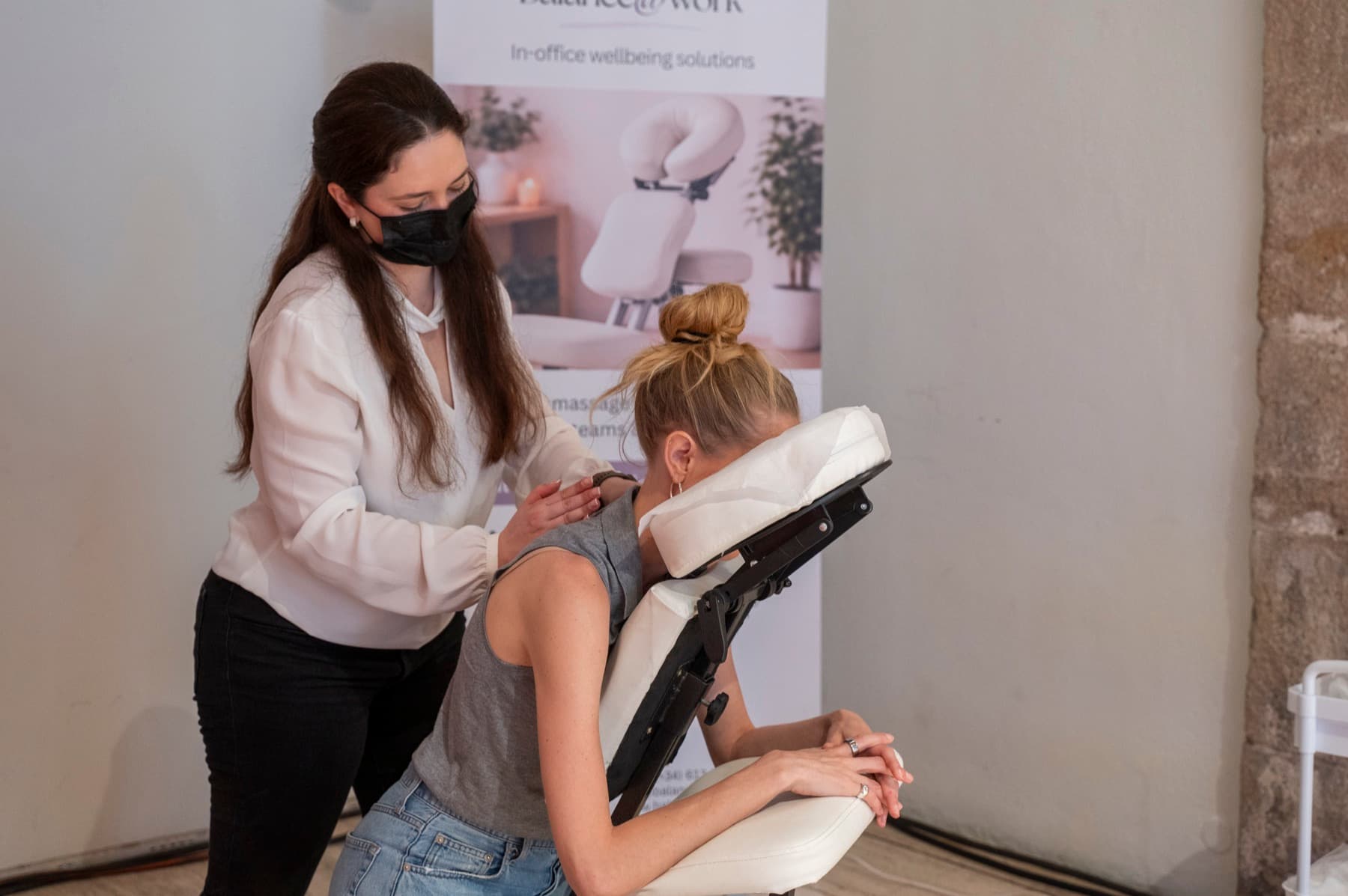
- Chair massage. 10-minute sessions, fully clothed and with no oils, spread throughout the day so everyone can release built-up tension between activities.
- Team session with a psychologist. The heart of the retreat: a group session led by a professional, focused on what the group needs, whether that is building cohesion, releasing tension or rediscovering motivation.
- Aromatherapy workshop. A screen-free sensory experience that helps people switch off, with something to take home.
- Time for the company. Many companies use part of the retreat for their own workshops or strategy sessions. The wellbeing programme is built around them, so work and rest reinforce each other.
Formats and prices
We work with two formats, always tailored:
| Format | Best for | Indicative price |
|---|---|---|
| One-day retreat | An intense pause without an overnight stay | From €150 per person |
| Two days, one night | Full disconnection and more time together | From €550 per person |
The final price depends on the venue, group size and activities. Two-day retreats usually include accommodation, meals, a private meeting room and the wellbeing programme. All prices exclude VAT.
How to plan it, step by step
- Define the moment and the goal. Does the team need to rest, reconnect or align? The answer shapes the whole programme.
- Choose the format and date. For a two-day retreat, start planning at least two months ahead, especially in spring and autumn.
- Pick the venue. A quiet place, not far from the city, with private rooms and outdoor areas. Around Barcelona there are excellent options by the sea or in the mountains.
- Design a programme with rhythm. Alternate movement, conversation and free time. A common mistake is overfilling the agenda: rest is part of the programme too.
- Communicate it well. Explain to the team why the retreat is happening and what is (and isn't) expected. Nobody should arrive thinking it's just another meeting.
- Follow up afterwards. Gather impressions and agree on one or two concrete commitments, so the retreat doesn't stay as just a nice memory.
Frequently asked questions
- How many people can take part?
- We design retreats for small and medium-sized teams. The ideal size depends on the goal: for deeper conversations, smaller groups work better.
- Do participants need any yoga or pilates experience?
- No. Sessions are done on a chair, without sportswear, and adapted to all levels.
- Where do retreats take place?
- At hotels and quiet venues in Catalonia, usually a short distance from Barcelona. We suggest options based on group size and budget.
- Can it be combined with the company's own work sessions?
- Yes, and it is very common. We keep space in the programme for your sessions and fit the wellbeing activities around them.
- Are sessions available in English?
- Yes. The whole programme can be delivered in English.
- How is it invoiced?
- The retreat is invoiced to the company: 50% on confirmation and the rest on completion.
Tell us what your team is going through and we'll design a programme around it.
Civil liability insurance · Single-use materials · No-obligation quote